How to Prepare for a Job Interview: A Step-by-Step Checklist
A complete interview prep checklist: research, five answers to rehearse, questions to ask, what to bring and wear, and the follow-up that gets remembered.
Preparing for a job interview comes down to five jobs done in advance: research the company, rehearse answers to the questions you know are coming, prepare questions to ask them, stage your logistics the night before, and follow up within a day. Do those five and you'll walk in more prepared than most of the candidates you're up against.
Here's the whole sequence as a checklist, from a week out to the thank-you note.
What should I do a few days before?
Research — about an hour, three targets:
- The company. What they make or do, who their customers are, anything recent (a new location, a product, a busy season). Two facts you can mention naturally beat twenty you memorize. Source: their website, their social pages, one news search.
- The role. Reread the posting slowly and highlight the repeated words — those are the skills they'll ask about. For each requirement, decide which of your experiences proves it.
- The people and the pay. If you know your interviewer's name, a quick look at their title helps you pitch answers at the right altitude. And check the going rate for the role in your area before the money question finds you unprepared.
Rehearsal — the highest-value hour of the week. Prepare spoken answers to the five near-certainties:
- "Tell me about yourself." Ninety seconds, present → past → future: what you do now, the experience that got you here, why this job is the next step. Not your life story — your work story.
- "Why do you want to work here?" Connect one true thing about them to one true thing about you. Specific beats flattering.
- "What's a strength?" Name one the job needs, then prove it with a story rather than adjectives.
- "What's a weakness?" A real one, plus what you do about it. Practiced honesty reads as maturity; "I'm a perfectionist" reads as a dodge.
- "Tell me about a time you [handled conflict / solved a problem / made a mistake]." Have three short stories ready in situation-task-action-result shape; most behavioral questions are one of these three wearing different clothes.
Rehearse out loud — answers that exist only in your head come out twice as long and half as clear. One run-through with a friend, mentor, or mirror is worth five silent reviews. If your story involves translating military service into civilian terms, there's a dedicated guide for that in How Should Veterans Talk About Their Service in a Job Interview?; if it involves explaining a gap, your script is in How to Explain an Employment Gap After Incarceration.
Questions to ask them — prepare three. An interview without questions from you reads as low interest. Reliable ones: "What does a typical day look like in this role?", "What separates people who do well here from people who don't?", "What are the next steps in your process?" — that last one also tells you when to follow up.

What should I stage the night before?
Ten minutes of staging prevents ninety percent of morning disasters:
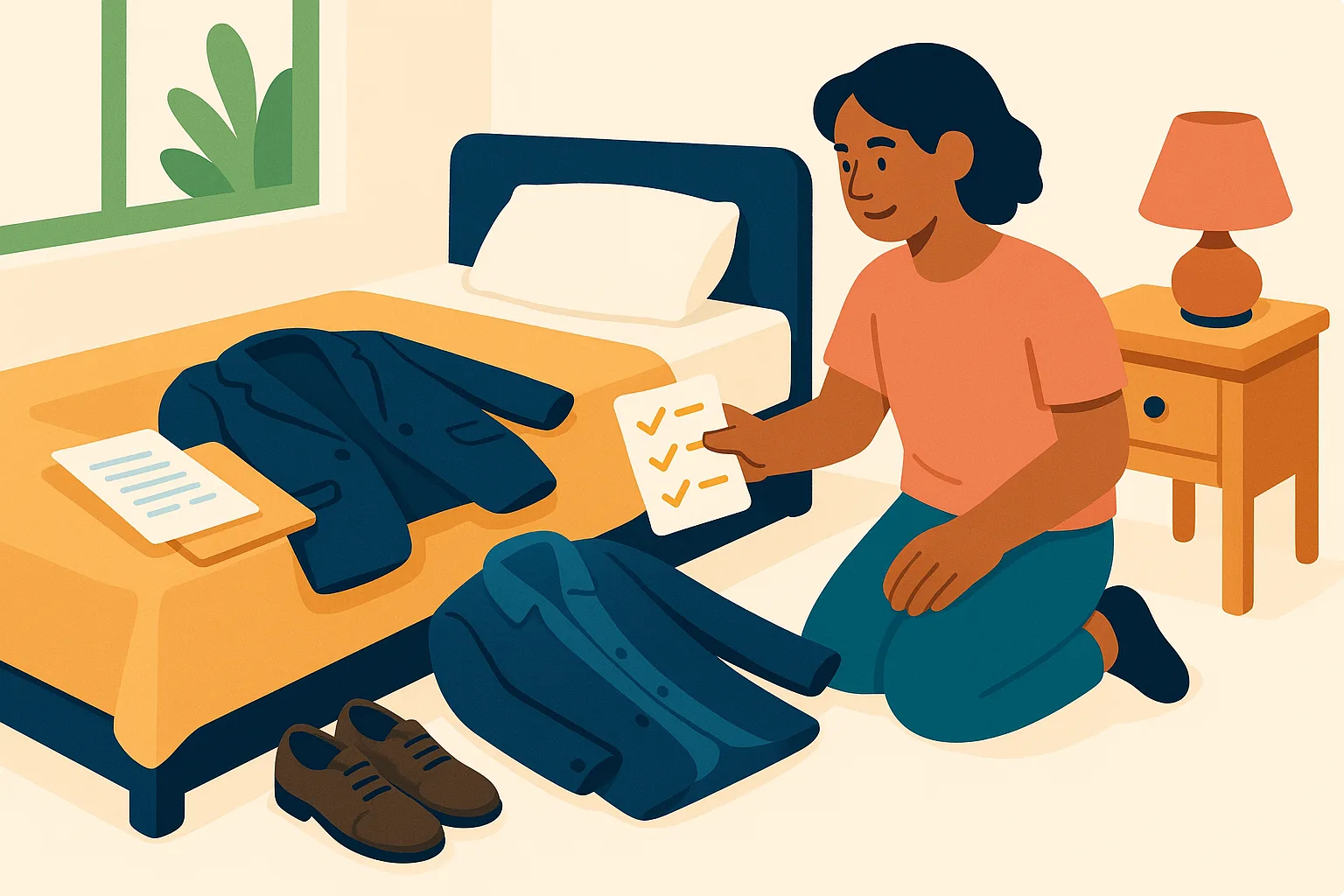
- Clothes out and checked — clean, pressed, one step nicer than the job's daily wear.
- Bag packed: two printed copies of your resume (yes, still — here's how to build one from scratch if you haven't), a notepad and pen, photo ID, reference list, and any certificates the role cares about.
- The trip planned: address confirmed, route checked at the time of day you'll travel, parking or transit figured out, aiming to arrive in the area thirty minutes early. Phone contact for the interviewer saved, in case the world intervenes.
- For video interviews: link tested, camera at eye level, light in front of you not behind, quiet space arranged, phone silenced, and the app updated tonight — not at 8:58 tomorrow.
- Sleep. Genuinely part of the checklist. A tired brain rehearses; a rested one performs.
What matters during the interview itself?
You've done the preparation; the day itself is mostly delivery:
- Be kind to everyone. The receptionist's impression gets asked for more often than candidates think.
- Open well: phone off (not vibrate — off), a firm handshake if offered, names remembered and used once or twice.
- Answer, then stop. Nerves manufacture rambling. Deliver the rehearsed answer, land the ending, and let silence be the interviewer's problem. Pausing three seconds to think before a hard question reads as composure, not weakness.
- It's a conversation, not an interrogation. Ask your questions when invited (or when a natural opening appears). You're also deciding whether you want them — interviewers can feel the difference, and it reads as confidence.
- Close deliberately. If you want the job, say so, plainly: "I'd be glad to do this work — what are the next steps?" Then thank them by name.
Does the checklist change for different interview formats?
The core five jobs stay the same; the staging shifts. Know which format you're walking into (it's fine to ask when scheduling) and adjust:
- Phone screen. Usually a recruiter checking basics and availability — short answers, energy in your voice (standing up helps), your resume and the job posting in front of you, and a quiet room. Its goal is only to earn the real interview, so keep answers to thirty seconds and don't try to close the job on the call.
- Video interview. Everything from the night-before list, plus: look at the camera when you speak (not the screen), close every other app, and have a phone-number fallback for when the platform misbehaves. If it does misbehave, calm troubleshooting is the interview.
- Panel interview. Several interviewers at once. Direct each answer to the asker, then sweep the others in with eye contact. Get names at the start, note them, and send each person a thank-you. Same answers as one-on-one — just distributed.
- Working interview or skills test. Common in trades, kitchens, warehouses, and increasingly in offices. The preparation is rest, the right clothes for actual work, and treating everyone you work beside as an interviewer — because they are, and their opinion gets asked afterward.
- Group interview. Multiple candidates together. The test is usually how you treat the other candidates, not just your answers. Be the person who listens and builds on others' points; interviewers hire the colleague, not the loudest voice.
What do I do after the interview?
The follow-through phase, where interviews are quietly won and lost:
- Same day: notes. Five minutes on what they asked, what landed, what you'd answer better, and any commitments made ("we'll decide by Friday"). This turns every interview into training for the next one.
- Within 24 hours: the thank-you email. Short, specific, to each person you met. Thanks, one detail from the conversation, restated interest. Five minutes, disproportionate impact.
- On the stated timeline: one polite follow-up. If they said Friday and it's Wednesday of the next week, a two-sentence check-in is professional, not pushy. One follow-up, then let it rest.
- Regardless of outcome: keep the pipeline moving. The strongest interview position is having another interview scheduled. If this one's a no, your notes just made the next one better — and a no from a good interview sometimes turns into a call about a different opening months later. They keep the resume; you keep the practice.
Interviewing is a learnable, repeatable skill — not a personality test you were born to pass or fail. Every item on this checklist is inside your control, which is exactly what makes it a checklist and not a lottery ticket. Work it in order, and walk in knowing you've already done the part most candidates skip.
Frequently asked questions
How early should I arrive for a job interview?
Arrive at the building ten to fifteen minutes early — enough to settle, not so early you crowd the interviewer's schedule. Plan the trip to get you there thirty minutes early, then wait nearby; the buffer absorbs traffic, parking, and finding the right entrance. For video interviews, be seated and logged in five minutes before.
What should I wear to an interview?
One step nicer than the job's daily dress code. For an office role, business casual or a suit depending on the industry; for warehouse, trades, or retail, clean and pressed casual — a collared shirt and intact, unwrinkled clothes. Clean and deliberate matters more than expensive. When unsure, ask whoever scheduled the interview; it's a normal question.
What if I don't know the answer to an interview question?
Say so, then show how you'd find out — 'I haven't done that yet; here's how I'd approach learning it.' Employers ask some questions to test honesty and composure, not knowledge. A calm 'I don't know, but' beats a bluff every time, because bluffs get follow-up questions.
How do I calm interview nerves?
Preparation converts most anxiety into readiness — nerves feed on the unrehearsed. Beyond that: rehearse out loud (not silently), do a practice run of the route or the video link, breathe slowly in the lobby, and reframe the meeting as a two-way conversation you're also evaluating. Some nervousness is normal and interviewers expect it; they're measuring how you function with it, not whether you have it.
Should I send a thank-you note after the interview?
Yes — a short email within 24 hours to each person you met. Two or three sentences: thanks, one specific thing from the conversation, and a restatement of interest. Few candidates do it, it takes five minutes, and hiring managers consistently mention it. If you don't have email addresses, one note to your main contact asking them to pass thanks along works.
Keep reading

How to Explain an Employment Gap After Incarceration
How to handle a resume gap from incarceration: what goes on paper, what to say out loud, and a practiced sixty-second answer that moves forward.

Getting a Job With a Criminal Record: The Complete Second-Chance Guide
A practical, judgment-free guide to finding work with a criminal record: where to look, how to handle the conversation, and how to rebuild momentum.

How Should Veterans Talk About Their Service in a Job Interview?
How veterans can turn military service into interview answers civilians understand: plain-language stories, 'I' statements, and the questions to expect.